

Yesterday, FERC granted a Voltus/Mission:data complaint against PJM, officially marking “data blocking” as an issue directly affecting wholesale market prices.

If your clean energy firm or nonprofit depends upon access to customer energy usage or billing data from utilities, it’s time to prepare for an abrupt shutoff.
The Green Button Explorer features an enhanced utility map as well as a comprehensive state policy views, creating a valuable resource for policymakers, regulators, and businesses. Users can explore utility-level data including Green Button status, AMI deployment status, real-time electric usage availabilityand smart meter investment ($), with over $31.5 billion tracked.
Today, Mission:data announces the Green Button Scorecard, which grades the quality of utilities’ data-sharing functionality. The Scorecard evaluates five (5) investor-owned utilities: ComEd, Consumers Energy, LG&E, Rockland Utilities (NJ) and Xcel Energy.

Monopolistic practices of utilities such as “data blocking” exclude rivals, contribute to sharply rising costs, and increase the risk of blackouts. The report describes how utilities are leveraging their exclusive control over electric meter data to block independent VPPs from operating.

“Because I said so” is not how the law works.
Today, the California Public Utilities Commission (CPUC) issued an extraordinary decision that guts protections for consumers in San Diego Gas & Electric (SDG&E) territory, taking away their ability to access real-time power usage information – a key tool to manage monthly utility bills. CPUC’s abrupt rejection of the law and complete disregard for longstanding precedent shows an unmistakable similarity to Donald Trump: governance through power grabs, the rule of law be damned.

Today, Mission:data and virtual power plant (VPP) leader Voltus, Inc. filed a complaint against PJM at the Federal Energy Regulatory Commission (FERC), alleging that PJM’s Open Access Transmission Tariff (OATT) violates the Federal Power Act because it obligates market participants to provide smart meter data, but utilities do not make such data available.
$5.4 billion in smart meter investments didn’t buy access to information. Instead, it bought customers “death by a thousand PDFs.”
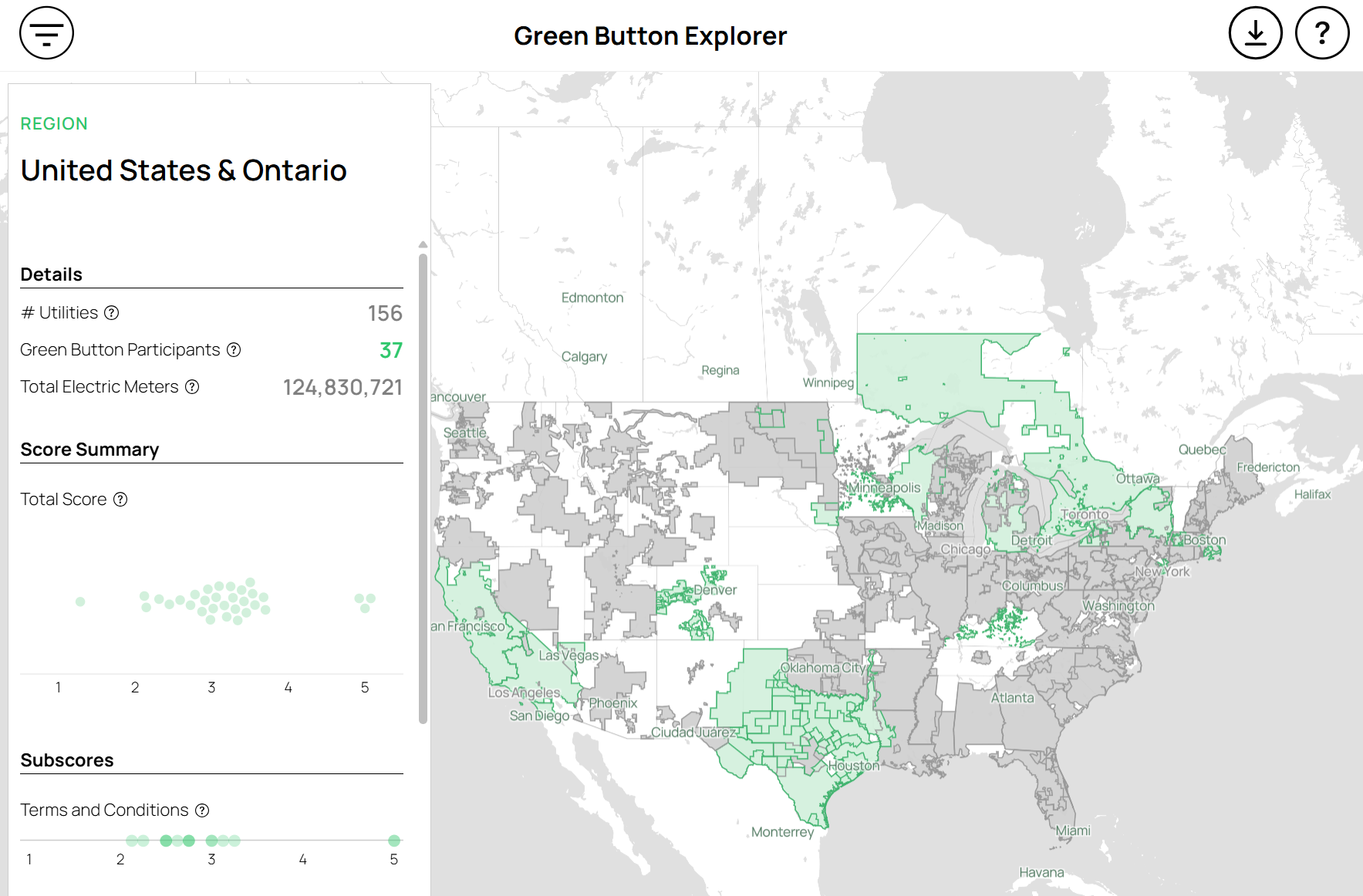
Mission:data has removed ComEd and Ameren Illinois Company from the Green Button Explorer because these utilities’ Green Button Connect offerings are non-functional — the first time we have demoted a utility for performance reasons.
We have also added Eversource (Massachusetts), Indiana Michigan Power Company, and Southwestern Electric Power Co (SWEPCO) to the Explorer.

Xcel claimed that customers can share their natural gas information with energy efficiency firms, but Mission:data’s Green Button Scorecard™ revealed that wasn’t true.
“By deceiving policymakers about natural gas information, Xcel has made it more difficult for families to consider alternatives to gas heating,” said Michael Murray, Mission:data’s co-founder and president. “By controlling your data, Xcel is curtailing your freedom to decide what’s best for you and your home.”

Now that it’s 2025, how should we improve permissioned access to energy data? What should policymakers focus on?
“Enforcement, enforcement, enforcement.”
That was my answer to a question posed last month at the Colorado Solar and Storage Association’s conference in Denver. Enforcement has been on my mind because of two contrasting events – one in American politics, the other involving utility regulation – that perfectly underscore its importance at this moment.

While Americans are focused on today’s election, today’s post looks at our northern neighbor. Ontario, Canada’s provincial regulation 633/21 calls for all electric and gas utilities in Ontario to offer Green Button Connect (GBC) by November 1, 2023. So, now that we’re one year into this policy, how are things going?
First some background. Ontario’s Green Button policy is unique in North America due to the sheer number of utilities that are involved - about 57. According to our Green Button Explorer, the USA has only 27 utilities with a GBC mandate. Thus, Ontario is a laboratory for the widest range of implementation types across North America. This variety essentially stress-tests the concept of standardization: supposedly, the regulation requires each utility to be certified by the Green Button Alliance. So our first-year review is also asking the question: Is certification working?

The Biden Administration’s actions in the past week demonstrate a truly remarkable bipolarity with regard to empowering consumers.
Yesterday, the Consumer Financial Protection Bureau (CFPB) issued sweeping data portability rules for banks and fintechs. Known as “open banking,” the requirements allow consumers to have their banking data – transaction history, interest rates and loan information – transferred seamlessly to competing services. The rules are the culmination of a multi-year commitment by the Democratic party to support customer choice, prevent “lock-in,” and fuel competition on price and service quality.
But last Friday in another part of the Biden Administration, the Department of Energy (DOE) dismissed data portability requirements entirely for $2 billion in grants to electric utilities.