

Xcel claimed that customers can share their natural gas information with energy efficiency firms, but Mission:data’s Green Button Scorecard™ revealed that wasn’t true.
July 28, 2025 – Mission:data Coalition, a nonprofit advocate for energy data portability, filed a motion for penalty on Public Service Company of Colorado (Xcel Energy) for making false and misleading statements in sworn testimony to the Colorado Public Utilities Commission. Xcel stated under oath that consumers have control over their natural gas information, including the ability to share it electronically with energy efficiency providers. In fact, Xcel does not have this capability, hindering electrification and decarbonization efforts, including the Colorado Energy Office’s new $70 million energy efficiency program.
The Commission may fine Xcel up to $9.4 million, calculated based on $20,000 per day, the maximum amount allowed under Colorado law, from the date the false statement was made.
“By deceiving policymakers about natural gas information, Xcel has made it more difficult for families to consider alternatives to gas heating,” said Michael Murray, Mission:data’s co-founder and president. “By controlling your data, Xcel is curtailing your freedom to decide what’s best for you and your home.”
Without control over natural gas data, it will be next to impossible for homeowners to quantify the relative costs and benefits of climate-friendly alternatives, such as heat pumps. When a home’s natural gas furnace dies due to old age, homeowners across Colorado will need to make kitchen-table decisions about whether to replace the furnace with a similar, gas-fired unit or whether to invest in an electric heat pump. A heat pump might have a higher up-front cost, but its monthly operating cost is potentially cheaper. Analyzing these particular costs and benefits is critical, but it becomes impossible to tailor the results to your specific home without access to your historical energy data, like gas usage and bill amounts.
Beyond individual homes, Xcel’s obfuscation could also render Colorado’s climate goals unattainable. Colorado has committed to net zero greenhouse gas emissions by 2050. The Colorado Energy Office has recently received grant funding of $70 million under the Inflation Reduction Act (IRA) to improve home energy efficiency, targeting tens of thousands of homes across the state. Without gas usage data available from Xcel in an electronic and scalable form, the state will struggle to pay homeowners the rebates, which must be calibrated to historical energy usage.
Holding monopoly utilities accountable for the claims made by Xcel’s experts is a prerequisite for the Public Utilities Commission to do its job. Xcel is currently asking the Commission to authorize over $7 billion of investments in distribution infrastructure, ostensibly in order to support Colorado’s shift to electric vehicles and away from gas heating. These investments may or may not be necessary, but one thing is certain: The Commission cannot chart a course for the future of energy in Colorado if it does not demand the truth from Xcel’s sworn experts about the present.
GREEN BUTTON CERTIFICATION ISN’T WORKING
In addition to making false statements under oath, this case highlights the flaws in the testing and certification process that is supposed to validate the features of each utility’s Green Button Connect implementation. Just as the U.S. Food and Drug Administration has an organic food certification, Green Button Connect can be certified by an independent body in order to ensure that utilities adhere to the technical standard.
But in this case, Xcel was able to obtain certification by the non-profit Green Button Alliance for Xcel’s natural gas functionality, even though such functionality does not exist. How was this possible?
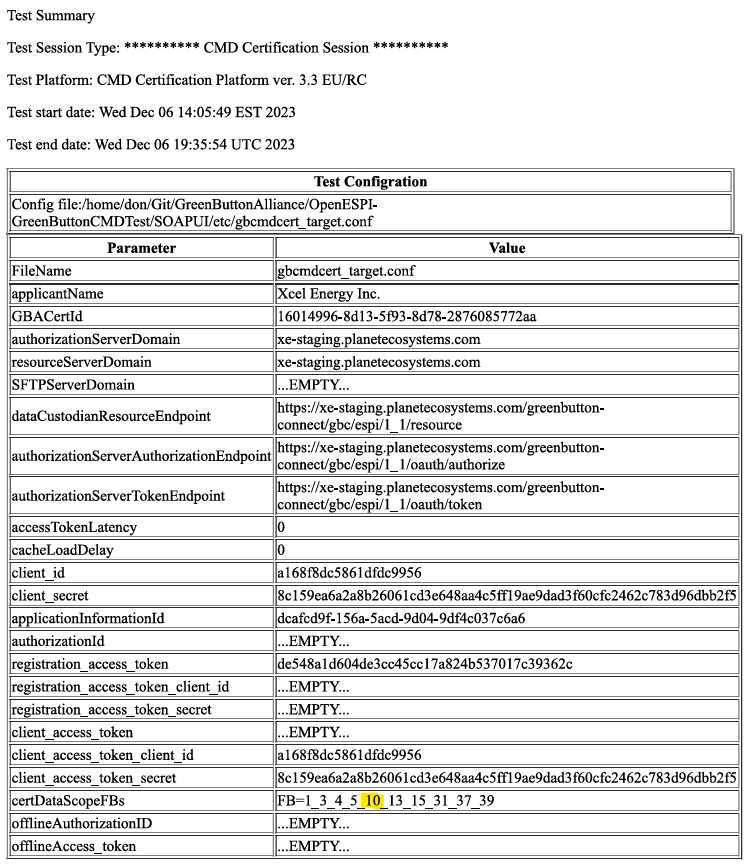
Function Block 10 is natural gas usage information per the technical documentation. Xcel received certification for natural gas but does not, in fact, offer this functionality.
This is not the first time that doubts have surfaced about Green Button Alliance certification. Last fall, we reported on “certified” utilities in Ontario, Canada that did not provide gas data for multi-site commercial customers. Other utilities had errors rendering their Green Button Connect implementations unusable; some utilities abruptly cancelled data-sharing arrangements between customers and energy efficiency firms without explanation. This occurred despite each of the utilities having a “confirmed” and “certified” implementation.
Ultimately, certifications are only useful if they are trustworthy. This is why Mission:data created the Green Button Scorecard™: to supplement certification with a “real world” evaluation. Too often, utilities across North America have made claims about their Green Button Connect systems that do not withstand scrutiny. Unfortunately, “certification” is not reliable.