
July 30, 2026 — Yesterday, FERC granted a Voltus/Mission:data complaint against PJM, officially marking “data blocking” as an issue directly affecting wholesale market prices. FERC found that PJM’s Open Access Transmission Tariff (OATT) violates the Federal Power Act because it obligates market participants to provide smart meter data, but utilities do not make such data available.
Previously, PJM's tariff said, in essence: If the customer has a smart meter, you MUST provide that smart meter data to us in order to get paid. FERC found that was unjust, unreasonable and unduly discriminatory, noting that utilities and their affiliates have access to meter data while the competitive market does not. FERC concluded: “We find that Complainants have provided ‘specific, demonstrable evidence’ that CSPs [curtailment service providers] cannot reasonably access residential customers’ interval meter data with the efficiency and scale needed to effectively participate in the ELRP [emergency load response program].”
In other words, accessing smart meter data is like “death by a thousand PDFs.”
Over $8.9 Billion Spent on Smart Meters
In PJM, 86% of all customers have a smart meter. The total cost of metering exceeds $8.9 billion in the PJM region, according to our accounting.
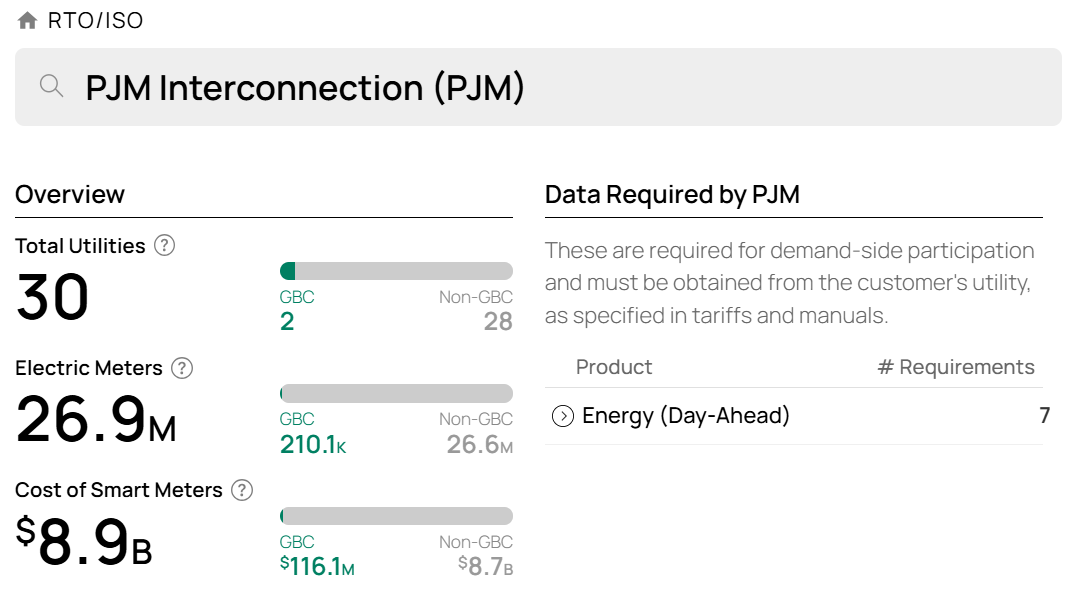
Utilities chronically underutilize their existing assets, contributing to unnecessary rate increases. The Brattle Group recently estimated that Americans could save $110 billion to $170 billion over 10 years simply by increasing the utilization of the grid. Smart meters are no different. Americans have spent over $31.7 billion on smart meters. But smart meter data – measurements of power usage generally at 15-, 30- or 60-minute intervals – is sitting on the sidelines and can’t be used to compensate distributed energy resources (DERs). We could squeeze more value out of the grid we’ve already paid for, but utilities stand in the way: They don’t like smart meter information being shared because demand response reduces their profits.
Commissioner LaCerte’s Dissent
Commissioner LaCerte contends that the inaccessibility of utility meter data is solely a result of state policy. According to LaCerte, states that prohibit data portability are doing so because it is their deliberate intention, not because utilities are using discriminatory and exclusionary conduct to avoid competition.
In our experience, state privacy laws are a thin excuse used by utilities to protect their self-interest. Utility commenters in the FERC docket claimed that privacy laws prevent them from sharing data with any third party. But this completely ignores customer consent. There is no privacy violation when a customer wants their information shared. Indeed, not a single law or regulation cited by the utility commenters elevates data protection above customer intentions. Moreover, numerous utilities nationwide operating under strict privacy laws (such as California’s) have built secure, permission-based data sharing systems. Where Commissioner LaCerte errs is by taking the utility commenters' claims at face value. Instead, he should have seen utilities' treatment of meter data as a choice intended to undermine competition.
FERC implicitly recognizes Baxter’s Law
From the telecom sector, Baxter's law says that monopolists in a regulated market (electricity delivery) have an incentive to dominate adjacent, competitive markets in which the regulated product (e.g., meter data) is an input. Think about mobile phones and modems, which AT&T blocked for decades because it wanted to monopolize various markets adjacent to landlines.
Yesterday, a FERC majority implicitly recognized Baxter’s Law is at work in the power sector and deemed "data blocking" to be unjust, unreasonable and unduly discriminatory as defined by the Federal Power Act.
We’ll have more to say about the remedy and FERC’s briefing topics in the near future. But for now, we’re pleased FERC recognized data blocking as the significant problem that it is. For 12 years, Mission:data has taken the position that the data generated by smart meters belongs to customers, and that utilities must honor any data-sharing request by customers. Failure to do so will result in downstream harms to energy efficiency, customer choice, and yes, wholesale markets. We’re very glad that FERC concurs.